

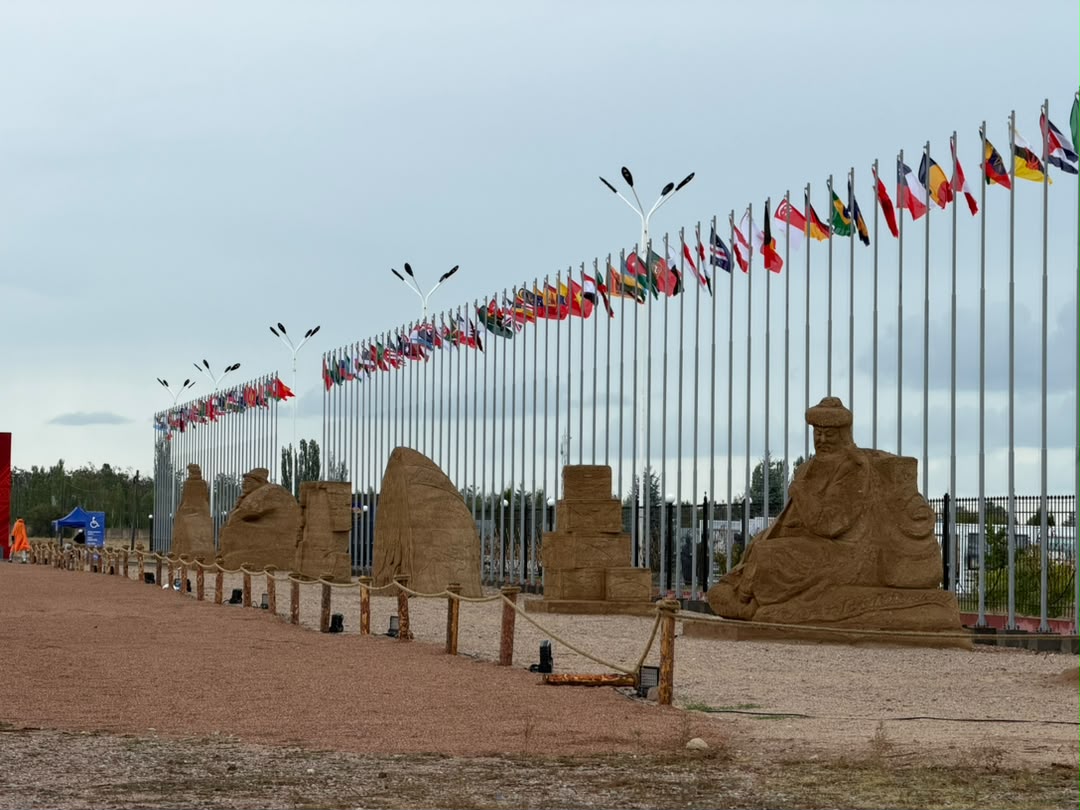
In the village of Ornok in the Issyk-Kul district, on the grounds of the Kurmanjan Datka Centre of Nomadic Civilisation, sand has become a material for art. As part of the cultural programme of the VI World Nomad Games a series of large sand sculptures has been created here, among them “Muun” (“Generation”) by sculptor Almaz Zhamgyrchiev.
The sculptor says his work with sand began back in 2016, when he took part in the symposium “The Magic Sands of Issyk-Kul”. Since then artists have developed the technique, combining the traditional idea of working with sand and earth with modern methods. A special mix with a binding agent gives the sculptures their strength.
Today individual sand compositions reach about five metres in height and length. They were chosen through a competition: from some 20 submissions the works selected were those meant not only to adorn the space but to become part of the cultural history of the VI Games.
For Almaz Zhamgyrchiev what matters in this work is not only technique and scale, but the chance to leave behind a piece that will still speak to the viewer years from now.
“If our works become part of history and stay in people's memory — for us, people of art, that is already the greatest victory,” the sculptor says.
So sand, usually associated with something fleeting, becomes in Ornok an image of a generation and a mark of the VI World Nomad Games.