

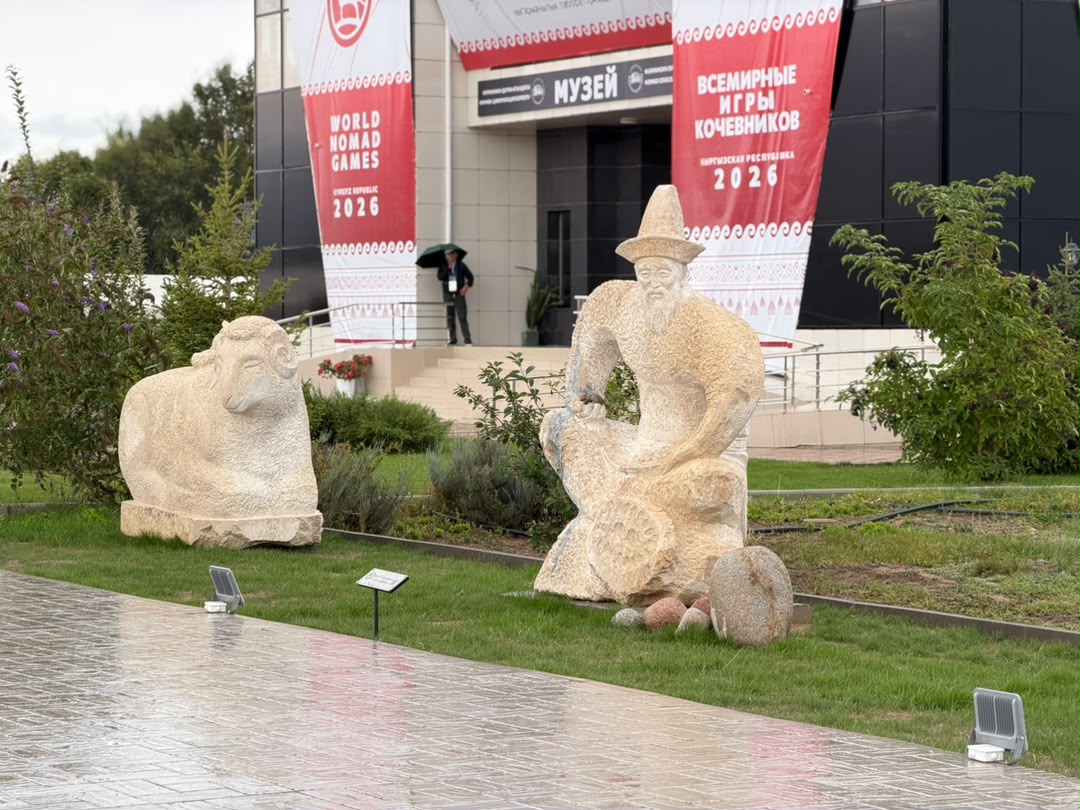
In the village of Ornok in the Issyk-Kul district, on the grounds of the Kurmanjan Datka Centre of Nomadic Civilisation, a unique collection of monumental sculptures devoted to the history, culture and philosophy of nomadic civilisation has been created. The works were made especially for the VI World Nomad Games and will now remain at the Centre as part of its artistic space.
The sculptors' work was preceded by an open competition announced while the cultural programme of the Games was being prepared. More than 75 entries were submitted, from which a special commission selected 16 projects to be carved in stone.
After the selection the sculptors came to Ornok and spent a month, immediately before the Games began, working on their compositions. Uzgen travertine was chosen for the works — a natural stone that allowed large monumental forms.
Today these 16 works already stand on the grounds of the Centre of Nomadic Civilisation. Their subjects are drawn from the history, traditions and spiritual values of the nomadic world: among them are “Ozok” (“The Core”), “Return of the Nomads”, “Tradition”, “Nomadic Spirit”, “Zhargylchak”, “Music”, “Freedom”, “Sayapker”, “Shaman”, “Toguz Korgool”, “Meikindik” and others.
Sculptor Bakyt Imanbaev presented “Zhargylchak”, a decorative composition devoted to a traditional household object of Kyrgyz women. The zhargylchak was used to grind grain and make flour and talkan, and was an inseparable part of nomadic life.
The first sketch of this composition was made by the sculptor while he was a second-year student at the Kyrgyz State Art Academy. The first version of the work was later sold to a foreign tourist. When the chance to take part in the symposium came, the artist returned to the image, since it fitted the theme of nomadic civilisation so naturally.
One of the central works of the symposium was “Ozok”, devoted to the foundations and origins of nomadic culture. In it the authors combined traditional ornament with contemporary imagery, showing that nomadic culture continues to develop today.
For the organisers and the sculptors themselves it matters that the works are not a temporary display. They will remain on the grounds of the Centre of Nomadic Civilisation.
“Today we look at balbals and tell from them what time they belong to, what era they come from. In the same way our compositions will speak years from now about the VI World Nomad Games — that such games were held here in 2026, and what ideas we wanted to convey,” the sculptor said.
The grounds of the Centre are thus gradually turning into a kind of open-air museum where contemporary art meets the history and traditions of nomadic civilisation.
The sixteen stone works created during the days of the World Nomad Games will stay here for a long time — as a memory of the event Kyrgyzstan hosted in 2026, and as evidence of how contemporary artists see the heritage of the nomadic world.