

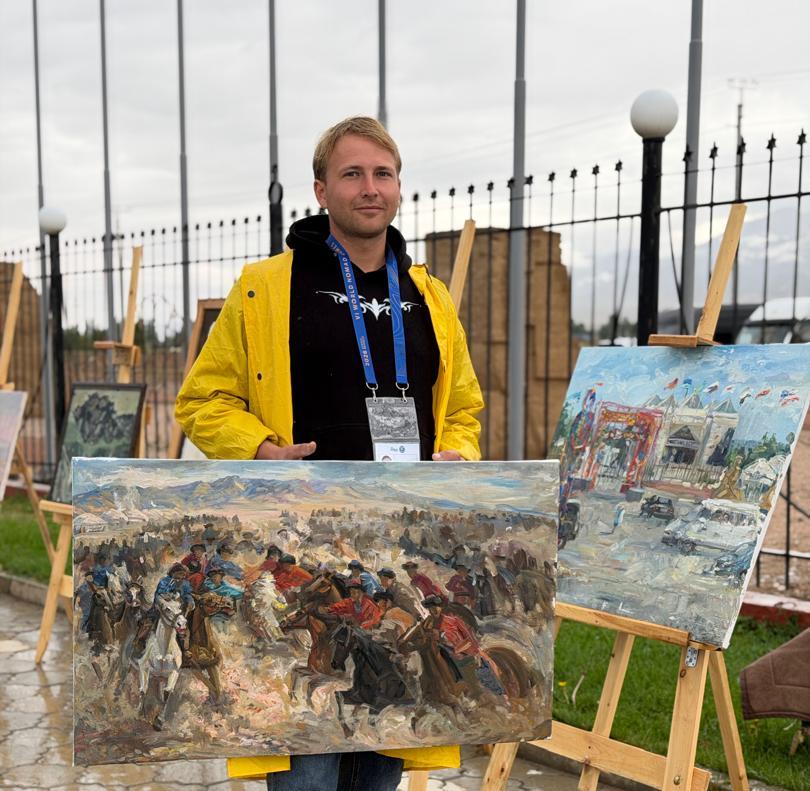
At the Kurmanjan Datka Centre of Nomadic Civilisation, guests of the VI World Nomad Games can not only discover the history and traditions of nomadic civilisation but also see how contemporary art rethinks national heritage. One of the participants in the art programme is 27-year-old painter Sergey Khudoleev.
At the main exhibition Sergey presented a large work, “Alaman-Ulak”, along with several studies — small independent pieces made while searching for the composition and the image.
The painting is devoted to one of the best-known Kyrgyz national games, alaman-ulak. For the artist, however, it is not simply a depiction of a contest between riders.
“The struggle goes on not only outside but inside; it is a person's inner struggle,” Sergey explains, speaking of the central philosophical idea of the work.
The idea came after a trip to Naryn. Having seen alaman-ulak for himself, the artist began gathering visual material, studying photographs and video, looking for characteristic silhouettes and images. Numerous sketches and small versions of the composition followed.
Sergey worked on the largest version of the painting for about a month. But the work, he says, began much earlier — for several years he collected material and observations, gradually searching for the image that finally took shape on canvas.
Today Sergey lives and works in Kyrgyzstan. He comes from the village of Sadovoye in the Chuy region and teaches at the Bilimkana school, working with children; after his main job he continues painting in his own studio.
His work today runs in several directions — portraiture, historical and national composition, and abstraction. The artist admits that he is still searching for himself and trying new forms.
Among the masters who influenced him Sergey names the Peredvizhniki, and among Kyrgyz painters — Semyon Chuikov and Gapar Aitiev.
Despite his youth, the artist has already held small exhibitions, and his works find buyers far beyond Kyrgyzstan.
Only the other day Sergey sold one of his paintings to foreign guests. The work devoted to alaman-ulak is now going to London.
“They liked my technique very much. They took the painting to London and plan to come again to see my studio in Bishkek,” the artist said.
For Sergey this is not simply the sale of a painting. It is a chance to show Kyrgyz art to an international audience.
That is why he considers taking part in the World Nomad Games important for the country's culture.
“The World Games give Kyrgyzstan a chance to introduce the world to our traditions. Events like this create a platform for exchange between countries, people and points of view,” Sergey said.
The artist now has about 30 paintings of his own; a large part of his other works has already found owners. In the coming years he plans to assemble a collection of large canvases and hold a major solo exhibition.
His ambitions, though, reach well beyond a single show.
“I want to take the local colour of Kyrgyzstan itself and bring it onto the international stage. To create, as in Soviet times, our own Kyrgyz miracle, so that Kyrgyzstan is heard around the world,” the young artist says.
In his work national culture becomes not a museum exhibit but a living artistic language — contemporary, recognisable and clear to viewers beyond the country's borders.
And perhaps one such painting has already begun that journey: the story of alaman-ulak, painted by a Kyrgyz artist, now continues far beyond Kyrgyzstan — in London.